Employee training has changed a lot over the years. Traditional training usually involves presentations, videos, manuals, classroom sessions, or watching an experienced employee perform a task. While these methods are useful, they don’t always give employees the opportunity to practice what they learn in a realistic environment.
This is where Virtual Reality (VR) is making a difference.
With VR, employees can enter a simulated digital environment and practice tasks as if they were actually performing them in the real world. They can make mistakes, repeat activities, and improve their skills without putting themselves, customers, equipment, or the business at unnecessary risk.
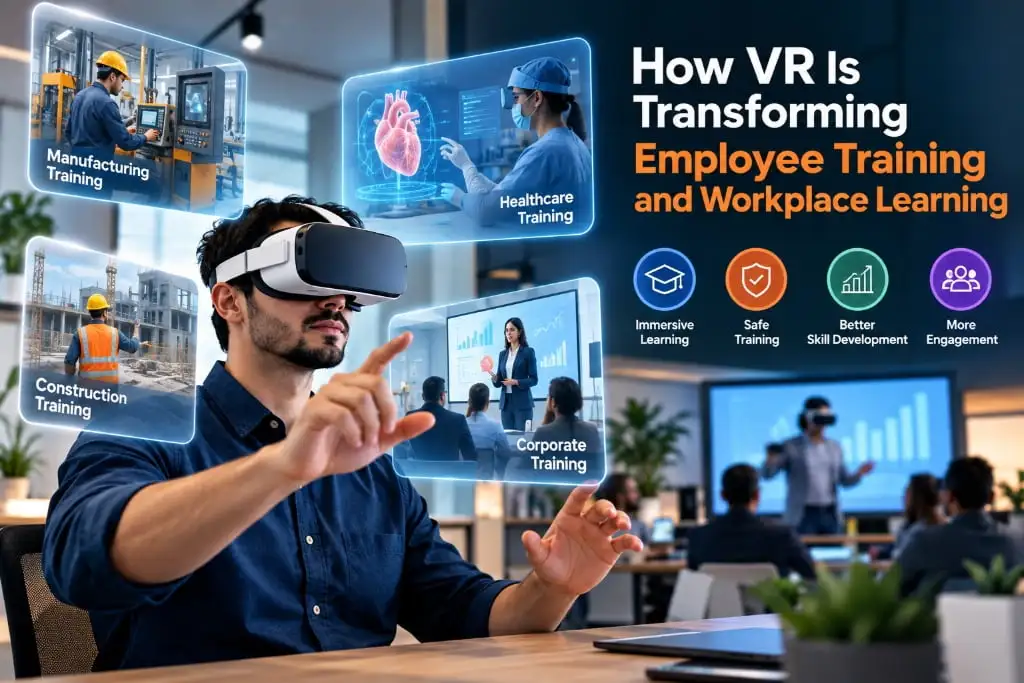
From manufacturing and healthcare to retail, construction, aviation, and corporate training, VR is creating more interactive and practical learning experiences.
What Is VR-Based Employee Training?
VR-based training uses a VR headset and specialized software to create a simulated environment.
Instead of sitting in a classroom and simply listening to instructions, an employee can put on a VR headset and enter a virtual workplace.
For example, a factory worker can practice operating machinery in a simulated factory. A healthcare professional can practice a medical procedure in a virtual environment. A new employee can even explore a virtual workplace and learn different processes before starting their actual job.
The goal isn’t simply to make training look futuristic. The real purpose is to make learning more practical, engaging, and repeatable.
How VR Can Improve Employee Training
1. Employees Can Learn by Doing
One of the biggest advantages of VR training is the ability to learn through practice.
Reading instructions about how to operate a machine is very different from actually practicing the process.
VR allows employees to interact with virtual equipment, follow procedures, make decisions, and experience different situations.
This can make complex concepts easier to understand because employees are actively participating instead of simply watching or listening.
2. Safe Training for High-Risk Jobs
Some jobs involve situations where mistakes can be dangerous or expensive.
Industries such as construction, manufacturing, aviation, healthcare, and emergency services can use VR to simulate potentially risky scenarios.
For example, employees can practice emergency procedures, equipment handling, safety protocols, or disaster response in a controlled virtual environment.
They can experience the situation without facing the actual physical risks associated with real-world training.
3. Employees Can Practice as Many Times as Needed
Everyone learns at a different speed.
In a traditional training session, employees may have limited opportunities to repeat a particular task. With VR, training modules can usually be accessed repeatedly.
An employee who needs additional practice can repeat the same scenario until they become more comfortable with the process.
This creates a more flexible learning experience and allows organizations to provide consistent training to different employees.
VR Makes Training More Engaging
Let’s be honest—long presentations and training videos aren’t always exciting.
VR can make training more interactive by placing employees inside the learning environment.
Instead of looking at a screen showing a workplace, employees can look around a virtual workplace and interact with objects, tools, equipment, or digital characters.
Organizations can also create scenarios where employees have to make decisions.
For example, a customer-service training simulation could present a difficult customer situation. The employee chooses how to respond, and the training system can provide feedback based on their actions.
This makes training feel more like an experience than a traditional lesson.
VR Can Support Different Industries
The possibilities for VR workplace training are broad.
Manufacturing: Employees can learn machinery operation, maintenance procedures, and workplace safety.
Healthcare: Medical professionals can practice procedures and emergency scenarios in simulated environments.
Construction: Workers can learn safety procedures, equipment handling, and site-related scenarios.
Retail: Employees can practice customer service, store operations, and different customer situations.
Aviation: Training can simulate aircraft operations, emergency procedures, and technical tasks.
Corporate Offices: Companies can use VR for leadership training, communication, presentations, onboarding, and team-building activities.
This flexibility makes VR useful for both technical and soft-skill training.
VR and Other Immersive Technologies
VR isn’t the only technology changing digital experiences. Augmented Reality (AR) is also being used by businesses.
For example, an AR shopping app can allow customers to visualize furniture in their homes or virtually try products before purchasing them.
The difference is that VR generally places the user inside a completely simulated environment, while AR adds digital elements to the real world.
Businesses can choose between these technologies—or combine them—depending on their goals.
How Much Does VR Training Development Cost?
The cost of developing a VR training solution depends on the requirements of the organization.
A simple training simulation with a limited number of environments may require less investment than a complex VR platform containing multiple scenarios, interactive characters, advanced 3D environments, analytics, assessments, and employee management features.
Some important factors that influence development cost include:
- Complexity of the VR environment
- Number of training modules
- 3D modeling and animation requirements
- Level of user interaction
- VR headset compatibility
- Voice and character integration
- Employee performance tracking
- Backend and admin dashboard
- Testing and ongoing maintenance
Businesses should first identify their training goals and required features before estimating the total development cost.
Why Choose Atina Technology for VR Development?
Creating an effective VR training experience requires more than simply building a virtual environment. It requires thoughtful UX design, 3D development, interactive scenarios, testing, and a clear understanding of how people learn.
Atina Technology helps businesses build customized VR solutions for employee training, workplace learning, simulations, product experiences, and other business requirements. We are experts in VR development and can create immersive experiences designed around your organization’s specific goals.
Whether you need a safety-training simulation, employee onboarding experience, technical training module, or an interactive virtual environment, the right VR solution can make workplace learning more engaging and practical.
The Future of Workplace Learning
Employee training is moving beyond classrooms and traditional videos. VR gives businesses an opportunity to create realistic environments where employees can practice, learn, make mistakes, and improve before applying their skills in the real world.
As VR technology continues to develop, training experiences can become more interactive, personalized, and accessible.
For organizations looking to modernize employee learning, VR isn’t just about creating an impressive virtual world. It’s about creating a better way to learn through experience.