
Online shopping has made life easier. You can browse hundreds of products, compare prices, read reviews, and place an order without leaving your home. But there is still one major limitation: you cannot physically experience the product before buying it.
This is where Augmented Reality (AR) is changing the shopping experience.
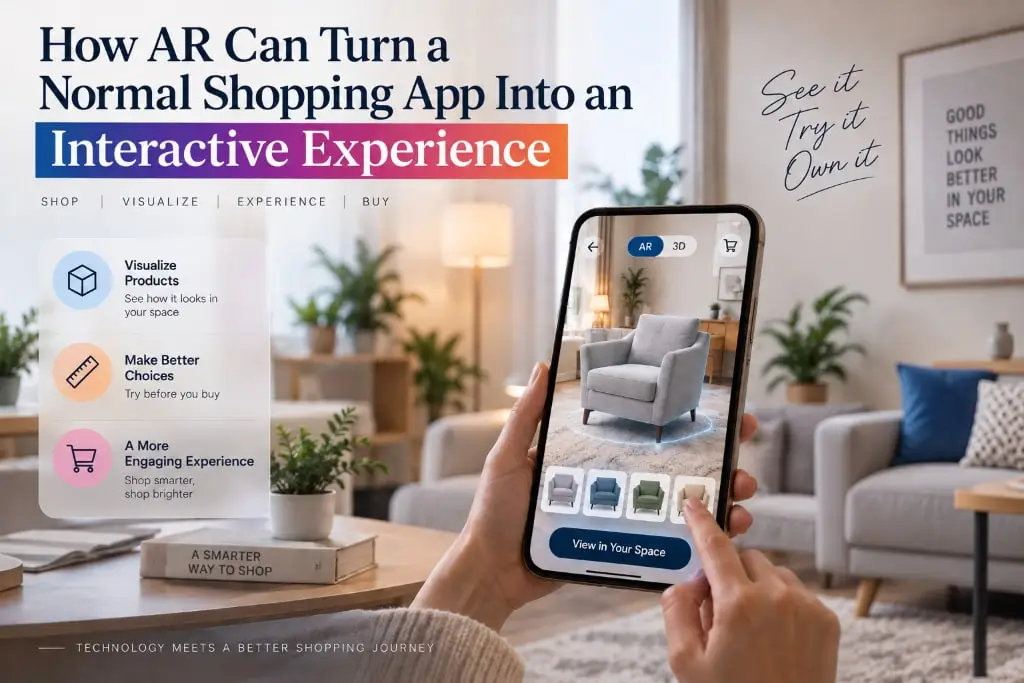
AR allows shoppers to use their smartphone camera to see how a product would look in their real surroundings. Instead of simply looking at a product photo, customers can interact with a digital version of the product through their phone.
For businesses and shopkeepers, this creates a more engaging way to showcase products, build customer confidence, and make shopping more interactive.
What Is AR Shopping?
AR shopping combines an online shopping app with augmented reality technology.
For example, imagine you are purchasing a sofa online. Instead of looking at a few product images, you can open the AR feature in the shopping app, point your phone camera toward your living room, and place a virtual sofa on the floor.
You can move it around, check its size, see how it looks in the room, and sometimes even change its color or design.
The same concept can be used for furniture, fashion, jewellery, home decor, cosmetics, electronics, automobiles, and many other products.
This turns a simple shopping app into an interactive product experience.
How AR Makes Normal Shopping More Interactive
1. Customers Can Visualize Products
One of the biggest advantages of AR is product visualization.
Instead of asking, “Will this look good in my room?”, customers can use AR to see the product in their actual environment.
For example:
-
Place furniture inside your room
-
Try different wall colors
-
Preview home decor
-
Visualize appliances in your kitchen
-
See how a product looks from different angles
This makes online shopping feel much closer to visiting a physical store.
2. Virtual Try-On Makes Shopping Easier
AR can also allow customers to virtually try products before purchasing them.
Fashion brands can let customers see how clothes or accessories may look on them. Jewellery businesses can allow customers to preview earrings, necklaces, watches, or glasses.
Beauty and cosmetic brands can use AR to let customers experiment with different shades or styles.
This gives shoppers a more personalized experience without physically trying every product.
3. Customers Can Interact With Products
Traditional shopping apps mainly show product photos, descriptions, and videos.
AR adds another layer of interaction.
Customers can rotate a 3D product, zoom in, change colors, explore different designs, and place the product in their surroundings.
This can make the product easier to understand and more memorable.
How Shopkeepers and Businesses Can Use AR
AR isn’t only useful for large e-commerce companies. Small businesses and local shopkeepers can also use AR to create better customer experiences.
For example, a furniture shop can create 3D models of its products and allow customers to visualize them at home.
A jewellery store can offer virtual try-ons through its website or mobile application.
An interior design business can use AR to show customers how furniture, flooring, lighting, or decor could look in their homes.
Retail stores can also use AR-based product demonstrations, interactive catalogs, promotional experiences, and social media filters to attract customers.
Instead of simply telling customers what a product can do, businesses can allow them to experience it digitally.
How AR Can Help Businesses Increase Sales
A major benefit of AR shopping is that it can help customers make purchase decisions with more confidence.
When customers can visualize a product before buying it, they may have a better understanding of its appearance, size, and overall suitability.
AR can also make a shopping app more memorable and engaging. A unique interactive experience can encourage customers to spend more time exploring products and sharing the experience with others.
However, AR should not be treated as a guaranteed sales solution. Its effectiveness depends on the product, user experience, implementation quality, and overall shopping journey.
What Does AR App Development Cost in India?
The AR App Development Cost in India can vary significantly depending on the complexity of the project.
A basic AR feature may cost less than a complete AR-powered shopping application with advanced 3D models, virtual try-ons, product customization, user accounts, payment integration, analytics, and backend systems.
Factors that can influence development cost include:
-
Complexity of the AR experience
-
Number of products requiring 3D models
-
Custom 3D modeling requirements
-
Android and iOS development
-
UI/UX design
-
Backend and API integration
-
Product customization features
-
Virtual try-on functionality
-
Testing and maintenance
A simple AR feature may be developed with a relatively smaller budget, while an advanced e-commerce AR platform can require significantly more investment.
Therefore, businesses should first define their requirements and desired customer experience before estimating the development budget.
Why Choose Atina Technology for AR Development?
Building a useful AR shopping experience requires more than simply adding a camera feature to an application. It requires thoughtful UI/UX design, AR technology, 3D assets, mobile development, testing, and integration with the existing shopping system.
Atina Technology helps businesses build customized AR solutions that turn ordinary digital experiences into interactive experiences. We are experts in AR development and can help businesses create AR applications, product visualization experiences, virtual try-ons, and other customized AR solutions based on their requirements.
Whether you are a retailer, e-commerce business, furniture store, jewellery brand, or another product-based business, AR can provide a new way to connect customers with your products.
Final Thoughts
Shopping is becoming more interactive. Customers don’t just want to see a product—they increasingly want to understand how it will look, fit, or work before making a purchase.
AR can bridge the gap between online browsing and real-world product experiences.
From visualizing furniture in your home to virtually trying on jewellery, AR can make a normal shopping app more engaging and interactive.
For businesses looking to stand out in a competitive digital market, investing in a well-designed AR shopping experience can be an exciting way to offer customers something beyond traditional product pages.