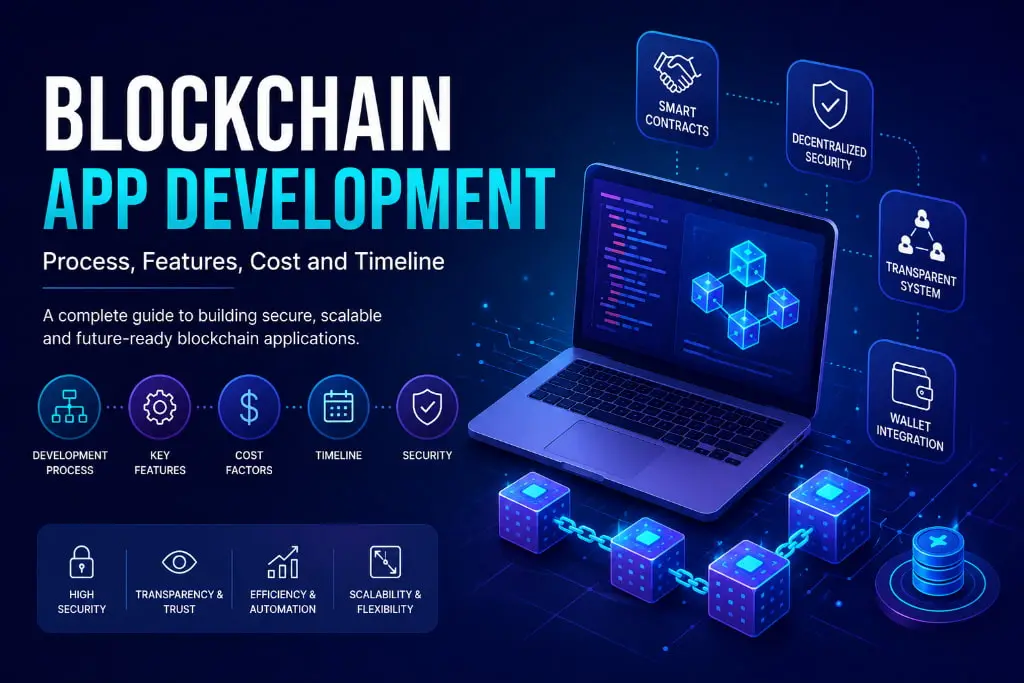
Blockchain technology has moved far beyond cryptocurrency. Today, businesses are exploring blockchain to improve security, transparency, automation, data management, payments, supply chains, digital identity, and many other processes. As adoption grows, blockchain development is becoming an important option for companies looking to build secure and decentralised digital solutions.
But before investing in a blockchain application, businesses usually have a few important questions: How is a blockchain app developed? What features should it have? How much can it cost? And how long does development take?
This guide explains the blockchain app development process, key features, cost factors, and timeline in simple terms to help you make a better decision.
What Is Blockchain App Development?
Blockchain app development is the process of creating an application that uses blockchain technology to store, verify, or exchange data securely. Unlike traditional applications where information is often controlled by a central system, blockchain-based applications can use distributed networks where records are shared and verified across multiple participants.
Depending on the business requirement, blockchain applications can be built for finance, healthcare, supply chain management, gaming, real estate, digital identity, logistics, and other industries.
Modern blockchain development can also integrate technologies such as artificial intelligence. AI blockchain development combines blockchain’s secure and transparent data infrastructure with AI capabilities such as automation, data analysis, intelligent decision-making, and fraud detection.
Blockchain App Development Process
Building a successful blockchain application requires more than writing code. A clear development process helps ensure the application is useful, secure, scalable, and aligned with business goals.
1. Define the Idea and Requirements
The first step is understanding the problem you want the blockchain application to solve. Identify your target users, business goals, required features, and whether blockchain provides a meaningful advantage over a conventional database.
2. Choose the Right Blockchain Platform
The next step is selecting a suitable blockchain platform and architecture. The choice depends on factors such as transaction requirements, privacy, scalability, fees, smart contract support, and whether the network needs to be public, private, or permissioned.
3. Design the Application
Developers and designers plan the application structure, user experience, workflows, data model, and blockchain interactions. A simple interface is especially important because users should be able to use the application without needing deep knowledge of blockchain technology.
4. Development and Smart Contracts
Once the design is ready, developers build the frontend, backend, blockchain integrations, APIs, and smart contracts where required. Smart contracts can automatically execute predefined actions when specific conditions are met.
5. Testing and Security
Testing is a critical part of blockchain app development. Developers test functionality, smart contracts, integrations, performance, permissions, and security before launch. Smart contracts deserve particular attention because mistakes in deployed code can be difficult or costly to correct.
6. Deployment and Maintenance
After successful testing, the application can be deployed to its intended environment. Development does not end at launch. Regular monitoring, security reviews, updates, performance improvements, and feature enhancements may still be required.
Key Features of a Blockchain Application
Features depend on the purpose of the application, but many blockchain solutions may include:
- Secure authentication: Helps protect user accounts and sensitive actions.
- Smart contracts: Automate transactions and business rules without manual processing.
- Transparent records: Authorised participants can verify relevant transaction history.
- Wallet integration: Useful for applications involving digital assets or blockchain transactions.
- Real-time transaction tracking: Allows users to follow transaction status and activity.
- Role-based permissions: Controls which users can view, add, approve, or manage information.
- AI integration: AI blockchain development can support fraud detection, analytics, automation, and intelligent workflows.
Not every blockchain app needs every feature. Choosing features based on actual user and business needs can reduce unnecessary complexity and development costs.
How Much Does Blockchain App Development Cost?
There is no single fixed price for developing a blockchain application. Cost varies significantly depending on the project’s scope, technical requirements, development team, and complexity.
Important cost factors include the type of blockchain, number of features, smart contract complexity, UI/UX design, wallet and third-party integrations, security requirements, testing, infrastructure, and ongoing maintenance.
A simple proof of concept will generally cost much less than a large enterprise application with multiple integrations, complex smart contracts, advanced security, and AI-powered functionality.
Before development begins, businesses should create a clear requirement document and request a project-specific estimate rather than relying on a generic price.
How Long Does Blockchain App Development Take?
The timeline also depends on project complexity. A small prototype or proof of concept may take several weeks, while a feature-rich blockchain application can take several months or longer.
The overall timeline typically includes planning, UI/UX design, architecture, development, smart contract creation, integration, testing, security reviews, deployment, and final improvements.
Complex requirements such as custom blockchain infrastructure, multiple external integrations, regulatory considerations, or AI blockchain development can increase the development timeline.
Final Thoughts
Blockchain applications can help businesses create secure, transparent, and automated digital systems, but successful development starts with a real business problem rather than simply adopting a new technology. Understanding the process, required features, cost factors, and expected timeline helps businesses plan their investment more effectively.
A well-designed blockchain application should balance security, usability, scalability, performance, and long-term maintainability.
At Atina Technology, we are experts in blockchain development and build powerful blockchain solutions designed around your business needs. Contact us to discuss your idea, and let us build powerful blockchain technology for you.