
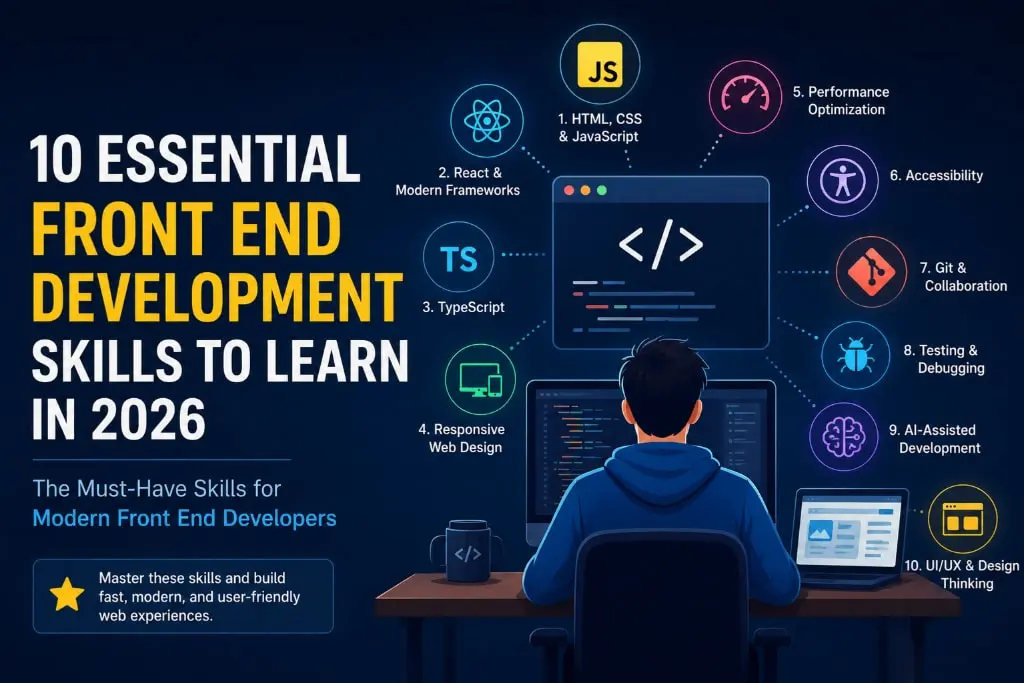
The world of web development is changing rapidly, and Front End Development is becoming more important than ever. Modern websites are no longer expected to simply look attractive—they need to be fast, responsive, accessible, secure, interactive, and easy to use. As businesses increasingly depend on their websites and web applications to generate leads, sales, and customer engagement, skilled front end developers are in high demand.
In 2026, learning only HTML, CSS, and basic JavaScript is not enough to stay competitive. Developers need a combination of strong fundamentals, modern frameworks, performance knowledge, testing skills, and AI-assisted development abilities. Industry learning roadmaps increasingly emphasize JavaScript, TypeScript, React, accessibility, performance, testing, and modern application architecture.
If you are planning to become a front end developer or want to upgrade your existing skills, here are 10 essential Front End Development skills to learn in 2026.
1. Strong HTML and CSS Fundamentals
HTML and CSS remain the foundation of every modern website. Even with advanced frameworks and development tools, developers need to understand how browsers interpret HTML and CSS.
A strong foundation helps developers create websites that are:
- Well-structured and easy to maintain
- Responsive across different screen sizes
- Visually consistent
- Accessible to different types of users
- Easier for search engines to understand
Developers should also become comfortable with modern CSS features such as Flexbox, CSS Grid, custom properties, responsive layouts, animations, and container queries.
2. Advanced JavaScript Knowledge
JavaScript is one of the most important skills for anyone pursuing a career in Front End Development. Modern websites depend on JavaScript for dynamic content, user interactions, animations, API communication, and application functionality.
Instead of learning only basic syntax, developers should understand how JavaScript actually works.
Important areas include:
- ES6+ features
- Promises and async/await
- APIs and asynchronous programming
- DOM manipulation
- Modules
- Event handling
- Closures and scope
- Browser events and the event loop
Strong JavaScript knowledge also makes it much easier to learn frameworks such as React, Vue, and Angular.
3. TypeScript
TypeScript has become an important skill for modern frontend developers because it adds static typing to JavaScript. This makes large applications easier to maintain and helps developers identify potential errors earlier.
TypeScript is particularly useful when working on large projects with multiple developers, reusable components, APIs, and complex application logic. Current frontend roadmaps increasingly treat TypeScript as a core production skill rather than an optional upgrade.
Developers should learn:
- Types and interfaces
- Generics
- Type narrowing
- Utility types
- Function typing
- Strict mode
- API response typing
4. React and Modern Frontend Frameworks
Framework knowledge is now an essential part of professional Front End Development. React remains a practical choice for many developers, while frameworks such as Next.js provide additional capabilities for building production-ready applications.
Rather than trying to learn every available framework, developers should become highly proficient in one major ecosystem.
For React developers, important concepts include:
- Components
- Props and state
- Hooks
- Routing
- Server and client rendering concepts
- Data fetching
- Component composition
- Reusable UI architecture
The goal should not be simply knowing how to use a framework, but understanding when and why to use different approaches.
5. Responsive Web Design
People access websites using smartphones, tablets, laptops, desktops, and increasingly different screen sizes. Therefore, responsive design is an essential skill for every frontend developer.
A responsive website automatically adapts its layout and content to the user’s device.
Developers should understand:
- Mobile-first design
- Media queries
- Flexible layouts
- CSS Grid and Flexbox
- Responsive images
- Touch-friendly interfaces
- Different screen resolutions
A website that works perfectly on a desktop but performs poorly on mobile can quickly lose visitors and potential customers.
6. Website Performance Optimization
Website speed directly affects user experience. Users expect websites to load quickly and respond smoothly, especially on mobile devices and slower networks.
Frontend developers should learn how to identify and solve performance problems rather than simply relying on development tools to report them.
Key techniques include:
- Image optimization
- Lazy loading
- Code splitting
- Reducing JavaScript bundles
- Removing unused CSS and JavaScript
- Browser caching
- Optimizing fonts
- Reducing unnecessary network requests
- Improving rendering performance
Developers should also understand how loading speed, responsiveness, and visual stability influence the overall experience.
Understanding Core Web Vital metrics is also useful when evaluating real-world website performance.
7. Accessibility
A modern website should be usable by as many people as possible, including users who rely on keyboards, screen readers, or other assistive technologies.
Accessibility should not be treated as something added at the end of development. It should be considered while designing and building components.
Important accessibility skills include:
- Semantic HTML
- Keyboard navigation
- Proper form labels
- Color contrast
- Focus management
- ARIA basics
- Screen-reader awareness
- Accessible buttons and interactive elements
Developers who understand accessibility can create better experiences while helping businesses reach a wider audience.
8. Git and Collaboration
Frontend development is rarely a solo activity in professional environments. Developers work with designers, backend developers, project managers, testers, and other engineers.
Git helps teams manage code, track changes, and collaborate efficiently.
Developers should know how to:
- Create and manage branches
- Commit changes properly
- Create pull requests
- Review code
- Resolve merge conflicts
- Work with GitHub or similar platforms
- Follow team development workflows
Strong collaboration skills can be just as valuable as technical knowledge when working on large projects.
9. Testing and Debugging
Writing code is only one part of professional development. Developers must also make sure that their applications work correctly.
Testing helps identify bugs before they reach users and makes future changes safer.
Frontend developers should gain practical knowledge of:
- Unit testing
- Component testing
- End-to-end testing
- Browser developer tools
- Error handling
- Debugging techniques
- Automated testing workflows
Tools such as Jest, Vitest, React Testing Library, Playwright, and Cypress can help developers build more reliable applications.
10. AI-Assisted Development
AI is becoming an important part of modern software development. However, learning how to use AI effectively is different from simply asking an AI tool to generate code.
In 2026, frontend developers can use AI to speed up repetitive tasks, explore solutions, generate initial code, improve documentation, identify potential bugs, and experiment with UI ideas.
The most valuable skill is knowing how to evaluate AI-generated code.
Developers should be able to:
- Write clear prompts
- Review generated code
- Identify incorrect or insecure suggestions
- Refactor AI-generated code
- Test generated functionality
- Use AI without losing fundamental programming knowledge
AI should be viewed as a development assistant rather than a replacement for technical understanding. Current frontend skill guides increasingly highlight AI-assisted workflows alongside traditional engineering fundamentals.
Final Thoughts
Front End Development in 2026 is about much more than creating attractive web pages. Developers need to understand the complete user experience—from writing clean HTML and JavaScript to building scalable applications, improving performance, ensuring accessibility, testing features, and using AI responsibly.
If you are starting your journey, focus on the fundamentals first and gradually move toward advanced technologies. A strong learning path can look like this:
HTML & CSS → JavaScript → TypeScript → React → Responsive Design → Performance → Accessibility → Git → Testing → AI-Assisted Development
Most importantly, don’t try to learn every new framework or tool at once. Build real projects, solve practical problems, and continuously improve your development skills.
Looking for Expert Front End Development Services?
Atina Technology is an expert in Front End Development, helping businesses build modern, responsive, high-performance, and user-friendly websites and web applications. With expertise in modern frontend technologies and development practices, Atina Technology can help turn your digital ideas into reliable and engaging web experiences.
If your business needs a professional website or a modern web application, partnering with an experienced Front End Development team can help you create a better digital experience and achieve your business goals.