
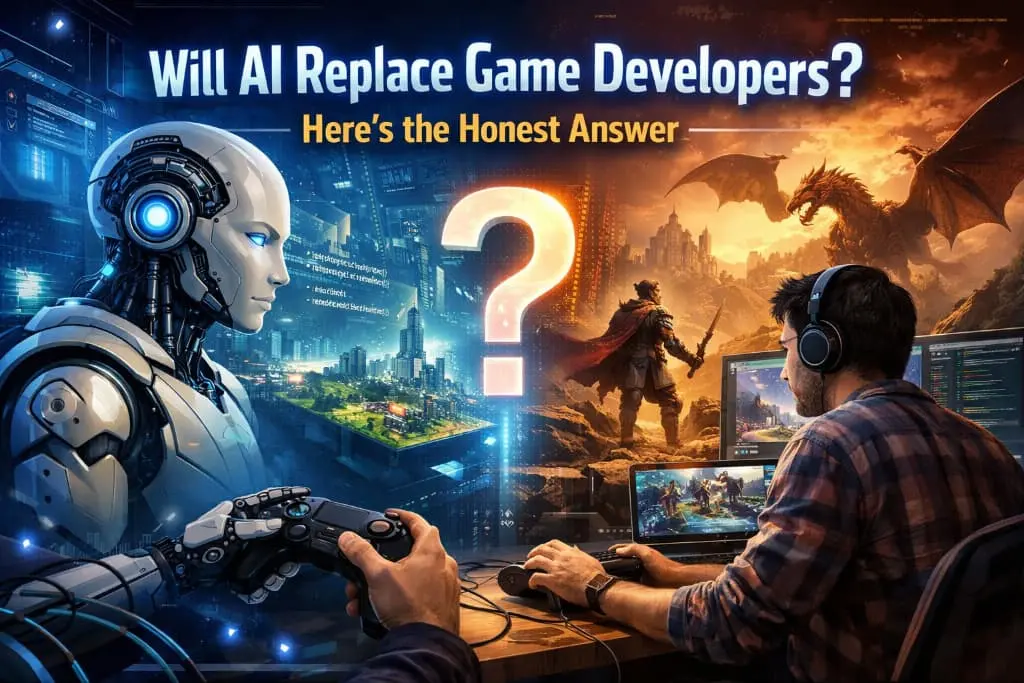
The question keeping every game developer up at night — is Artificial Intelligence coming for your job? The short, uncomfortable answer: it’s complicated. But here’s the truth most people are afraid to say out loud.
Every few months, a new AI tool launches and the internet erupts with bold declarations — “Gaming developers are finished!” or “Human creativity is irreplaceable!” Both camps are missing the bigger picture. The reality of how AI is reshaping game development is far more nuanced, more exciting, and honestly, more hopeful than either extreme suggests.
Let’s cut through the noise and get to what actually matters.
What AI Can Already Do in Game Development
Make no mistake — AI has become a genuinely powerful force in the game development pipeline. Today’s tools can generate stunning concept art in seconds, write functional code snippets, compose ambient music tracks, and even create 3D assets from text prompts. Studios like Ubisoft and EA are already using AI to automate repetitive tasks that once consumed hundreds of developer hours.
AI-powered tools can now handle NPC dialogue trees, generate procedural terrain, optimize performance bottlenecks, and even assist in quality assurance testing. These are real, undeniable capabilities — and pretending otherwise would be intellectually dishonest.
“AI won’t replace game developers. But game developers who know how to use AI will absolutely replace those who don’t.”
What AI Absolutely Cannot Do (Yet)
Here’s where the doom-and-gloom narrative falls apart. Game development is not just a technical discipline — it is an act of storytelling, emotion, and cultural expression. And that is precisely where AI hits a wall.
Great games are born from human experience. The gut-wrenching twist in The Last of Us, the deceptively simple joy of Minecraft, the philosophical depth of Disco Elysium — none of these emerged from an algorithm. They emerged from developers who felt something deeply and had the vision to translate that feeling into an interactive world.
AI cannot conceptualize. It cannot feel player frustration and course-correct with empathy. It cannot make the bold creative gamble that turns a mediocre concept into a masterpiece. It can remix brilliantly — but it cannot originate. That spark of genuine human creativity remains irreplaceable.
AI vs Human Developers: Where Each Excels
|
AI is Strong At |
Humans Excel At |
|
Repetitive asset generation |
Core creative vision |
|
Code autocompletion |
Emotional storytelling |
|
Bug detection & QA |
Game feel & polish |
| Procedural content creation |
Player psychology |
| Texture & audio drafts |
Bold artistic decisions |
The Real Shift: From Builder to Director
The role of a game developer is evolving — not disappearing. Think of it like the invention of digital cameras. Photographers didn’t vanish; they became more powerful. Similarly, the next generation of game developers will spend less time on mechanical production and more time on creative direction.
AI handles the scaffolding. Humans architect the vision. A skilled developer who knows how to prompt, guide, and refine AI-generated content will be able to produce games that previously required an entire team. This is not a threat — it is an extraordinary opportunity for indie developers and small studios to compete at a scale that was previously unimaginable.
The dangerous mistake is treating AI as a replacement rather than a collaborator. The developers who will thrive are those who master this collaboration — who understand both the creative craft of game development and the evolving toolkit that AI provides.
Should You Be Worried?
If your value as a developer is purely in writing boilerplate code or generating generic assets — yes, you should adapt. The market for low-skill, repetitive game development tasks will shrink dramatically over the next five years.
But if you invest in your creative thinking, your understanding of player psychology, your ability to build cohesive worlds with meaningful narratives — you will be more in demand than ever. The industry is not contracting. It’s expanding. Global game revenues are projected to surpass $500 billion by 2030, and the demand for exceptional game experiences has never been higher.
The future belongs to developers who are adaptable, creatively fearless, and technically curious. AI is not the enemy — stagnation is.
The Verdict
AI will not replace game developers. It will replace certain tasks that game developers perform — and in doing so, it will free the best developers to do what they do brilliantly: create worlds that move people. The game development industry is on the cusp of a renaissance, and the developers who embrace this moment will build things the world has never seen before.
The tools are changing. The opportunity is growing. The question is — are you ready to level up?
Ready to Build Your Dream Game?
We are Atina Technology — experts in professional game development with a proven track record of turning bold ideas into extraordinary gaming experiences. Whether you’re an indie creator or an enterprise brand, our team has the skills, passion, and technology to bring your vision to life.
Don’t let your game idea stay an idea. Contact us today and let’s build something legendary together.