Odoo ERP development is becoming an important solution for businesses looking to simplify operations, improve productivity, and manage multiple departments through a single platform. As companies grow, handling sales, accounting, inventory, employees, and customer information using separate software can become challenging. This is why many businesses are comparing Odoo ERP with traditional ERP systems to find the right solution for their long-term growth.
But which option is better for your business? Let’s explore their features, costs, customization options, and scalability.
What Is Odoo ERP and How Does It Work?
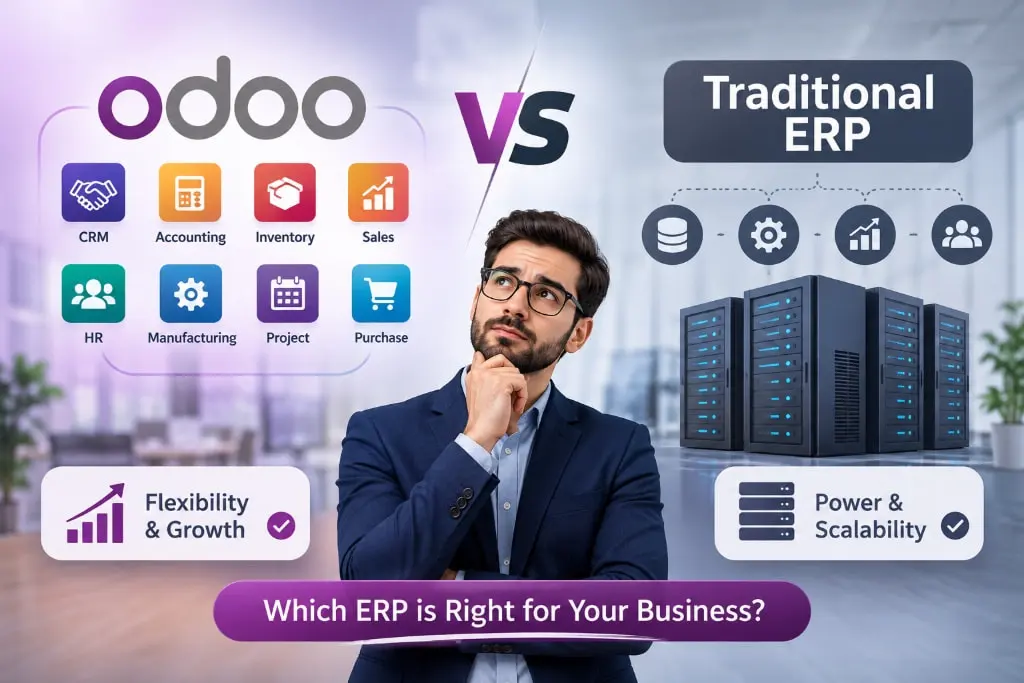
Odoo ERP is an integrated business management platform that provides multiple applications to manage different business activities. Its modular structure allows companies to select the applications they need and expand their system as their requirements change.
Some popular Odoo modules include:
- Odoo CRM: Manages leads, customers, and sales activities.
- Odoo Accounting: Simplifies financial management and invoicing.
- Odoo Inventory: Tracks stock, warehouses, and product movements.
- Odoo Sales: Manages quotations, orders, and customer transactions.
- Odoo HR: Supports employee and attendance management.
- Odoo Manufacturing: Helps organize production and planning.
These applications work together, helping businesses maintain connected information and reduce repetitive tasks.
What Is Traditional ERP Software?
Traditional ERP software is designed to connect different business departments through a centralized management system. It helps organizations manage accounting, procurement, manufacturing, inventory, human resources, and other essential operations.
Popular enterprise ERP platforms include SAP, Oracle ERP, and Microsoft Dynamics. These systems offer powerful business management capabilities, particularly for organizations with complex operations and specialized requirements.
However, implementation, licensing, customization, and maintenance costs can vary significantly depending on the platform and business needs.
Odoo vs Traditional ERP: Key Differences
Understanding the differences between these solutions can help businesses make better technology decisions.
|
Comparison |
Odoo ERP | Traditional ERP |
|
Cost |
Flexible pricing options | Varies by vendor and licensing |
|
Implementation |
Can be introduced module by module | Depends on system complexity |
|
Customization |
Supports custom modules and workflows |
Customization varies by platform |
| User Interface | Integrated, modern interface |
Depends on the software |
| Scalability | Add applications as needed |
Depends on architecture |
| Integration | Supports APIs and connected applications |
Supports integrations and connectors |
Odoo offers flexibility for businesses that want to start with essential applications and expand gradually. Traditional ERP platforms can also provide excellent scalability, especially for organizations with complex enterprise requirements.
Odoo ERP Benefits for Growing Businesses in Nagpur
Businesses looking for Odoo ERP benefits in Nagpur can consider how an integrated ERP system helps simplify daily operations and improve business visibility.
Some important benefits include:
- Centralized Management: Manage sales, accounting, inventory, and employees from one platform.
- Improved Productivity: Reduce repetitive manual work through automated workflows.
- Better Inventory Control: Monitor stock levels and warehouse activities more efficiently.
- Enhanced Customer Management: Track customer interactions, leads, and sales opportunities.
- Business Flexibility: Introduce additional applications as business requirements grow.
For startups, manufacturers, retailers, and service providers, these capabilities can help create more organized business processes.
Which ERP Is More Cost-Effective?
Cost is one of the most important factors when selecting ERP software. Businesses should consider more than just the initial subscription or licensing price.
Important expenses include:
- Software licensing or subscription fees.
- Implementation and customization costs.
- Employee training.
- Hosting and infrastructure.
- Technical support and maintenance.
- Future upgrades and integrations.
Odoo offers different editions and pricing options, making it possible for businesses to choose an approach that suits their requirements. However, the final investment depends on the selected applications, implementation scope, hosting, and customization.
Customization and Scalability: Which Is Better?
Every business has different workflows and operational requirements. Odoo supports customization through additional modules, custom reports, automated workflows, and third-party integrations.
As a business expands, it can introduce more applications, users, warehouses, and business processes. Traditional ERP platforms also provide customization and scalability, but the available options depend on the selected product and its technical architecture.
The right choice should support both current operations and future business expansion.
When Should You Choose Odoo ERP?
Odoo can be a suitable option for businesses that:
- Want to manage multiple departments through one system.
- Need flexible applications and customization.
- Want to automate repetitive business activities.
- Prefer gradually expanding their ERP functionality.
- Need better visibility into business performance.
Traditional ERP may be more suitable for organizations with highly specialized requirements, complex global operations, or existing enterprise systems that already meet their needs.
Final Verdict: Odoo vs Traditional ERP
Choosing between Odoo and traditional ERP depends on your business size, budget, operational complexity, and future goals. Odoo is a flexible option for businesses looking for connected applications, customization, and gradual expansion. Traditional ERP can be equally valuable for organizations requiring specialized enterprise capabilities.
Selecting the right implementation partner is equally important for successful ERP adoption. At Atina Technology, we help businesses streamline operations through customized ERP solutions, implementation, and integration services.
We are Atina Technology, and we are experts in Odoo ERP development. Contact us to explore how the right Odoo solution can support your business growth.