
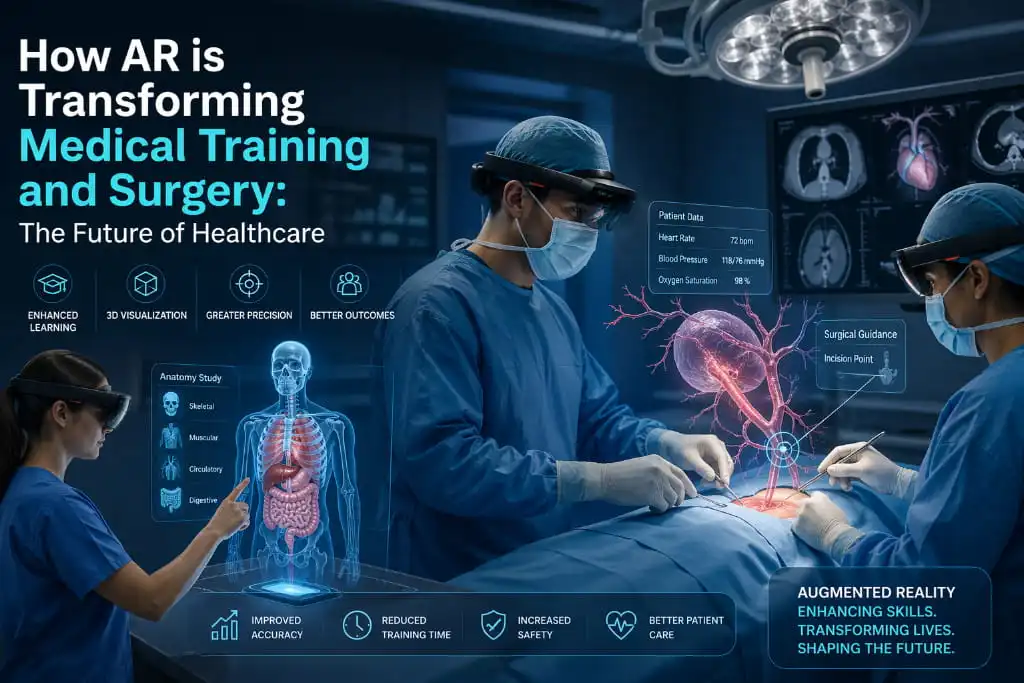
The operating room has always been a high-stakes environment where precision is non-negotiable. For decades, medical training relied on textbooks, cadaver labs, and learning by observation. But in 2025, a powerful technological shift is underway — Augmented Reality (AR) is redefining how surgeons are trained, how procedures are planned, and how operations are performed.
From overlaying 3D anatomical models onto a patient’s body during surgery to letting medical students practice complex procedures in a risk-free virtual environment, AR is not just a buzzword in healthcare — it is a transformative force saving lives and shaping the future of medicine.
What Is Augmented Reality in Healthcare?
Augmented Reality blends digital information — such as 3D models, labels, and real-time data — with the physical world through devices like AR headsets, tablets, or smart glasses. Unlike Virtual Reality (VR), which creates a fully immersive digital environment, AR enhances the real world by layering computer-generated visuals on top of it.
In healthcare, this means a surgeon can see a patient’s CT scan overlaid directly onto their body during an operation, or a medical student can practice suturing techniques on a virtual patient that responds to every move in real time.
Revolutionizing Medical Training
1. Risk-Free Surgical Simulations
One of the most significant advantages of AR in medical education is the ability to simulate surgeries without putting any real patient at risk. Platforms like Touch Surgery and Microsoft HoloLens-powered training modules allow students to perform virtual incisions, handle complications, and practice rare procedures repeatedly until they achieve mastery.
This replaces the traditional “see one, do one, teach one” model with a far more effective and ethical approach to learning.
2. Interactive 3D Anatomy Learning
Traditional anatomy textbooks are two-dimensional and static. AR changes this completely. Medical students can now use AR apps to visualize the human body in full 3D, rotate organs, peel back tissue layers, and examine structures that would be impossible to study otherwise.
Applications like Complete Anatomy and Visible Body are already used in top medical universities, dramatically improving spatial understanding and retention of complex anatomical knowledge.
3. Real-Time Guidance for Trainees
AR enables experienced surgeons to remotely guide trainees during live procedures. Through AR headsets, a senior surgeon located anywhere in the world can overlay annotations, arrows, and instructions directly into a trainee’s field of vision — creating a real-time mentorship experience that was never possible before.
Transforming Surgical Procedures
4. Pre-Surgical Planning with AR Overlays
Before a single incision is made, AR helps surgeons plan every step of the procedure with precision. By merging MRI or CT scan data with AR visualization, surgeons can map out the exact location of tumors, blood vessels, and nerves on a 3D model of the patient’s actual anatomy.
This pre-operative planning reduces surprises in the OR and enables a level of preparation that significantly improves surgical outcomes.
5. Intraoperative AR Guidance
Perhaps the most exciting application is live, real-time AR guidance during surgery itself. Neurosurgeons, for example, use AR headsets to see a patient’s brain activity data or tumor location overlaid directly on the surgical site — without having to look away at a separate monitor.
Companies like Medivis and Augmedics have developed FDA-approved AR surgical navigation systems that are already being used in spinal and orthopedic surgeries with remarkable results.
6. Improved Accuracy in Minimally Invasive Surgery
Laparoscopic and robotic surgeries involve operating through tiny incisions using cameras and instruments. AR enhances these procedures by superimposing critical information — organ boundaries, blood flow, and hidden structures — onto the surgeon’s live camera feed, dramatically improving accuracy and reducing complications.
The Measurable Impact on Patient Outcomes
The results speak for themselves. Studies have shown that AR-assisted surgeries result in:
- Up to 40% reduction in surgical errors
- Shorter procedure times due to better pre-surgical planning
- Faster recovery for patients due to increased precision
- Higher trainee confidence and competency before their first real procedure
These are not marginal improvements — they represent a paradigm shift in what is achievable in modern medicine.
Challenges and the Road Ahead
Despite its enormous potential, AR in healthcare still faces real challenges. High hardware costs, integration with existing hospital systems, regulatory approvals, and the steep learning curve for medical staff are all hurdles the industry is actively working to overcome.
However, as AR headsets become more affordable and lightweight, and as AI-powered image recognition improves, these barriers will continue to fall. The global AR in healthcare market is projected to exceed $4.6 billion by 2028, signaling massive industry confidence in this technology.
Conclusion
Augmented Reality is no longer a futuristic concept reserved for science fiction — it is actively saving lives, training better surgeons, and pushing the boundaries of what modern medicine can achieve. Whether it is a first-year medical student mastering anatomy through interactive 3D models or a seasoned neurosurgeon guided by real-time AR overlays, this technology is making healthcare safer, smarter, and more effective.
The medical field is being augmented — and the possibilities are limitless.
Partner with Experts Who Understand AR
At Atina Technology, we are passionate about building cutting-edge AR solutions that drive real-world impact. Whether you are looking to develop AR-powered medical training platforms, surgical navigation tools, or immersive healthcare applications, our expert AR development team is ready to bring your vision to life.
Let’s build the future of healthcare together.
Contact us and let’s discuss your AR project.