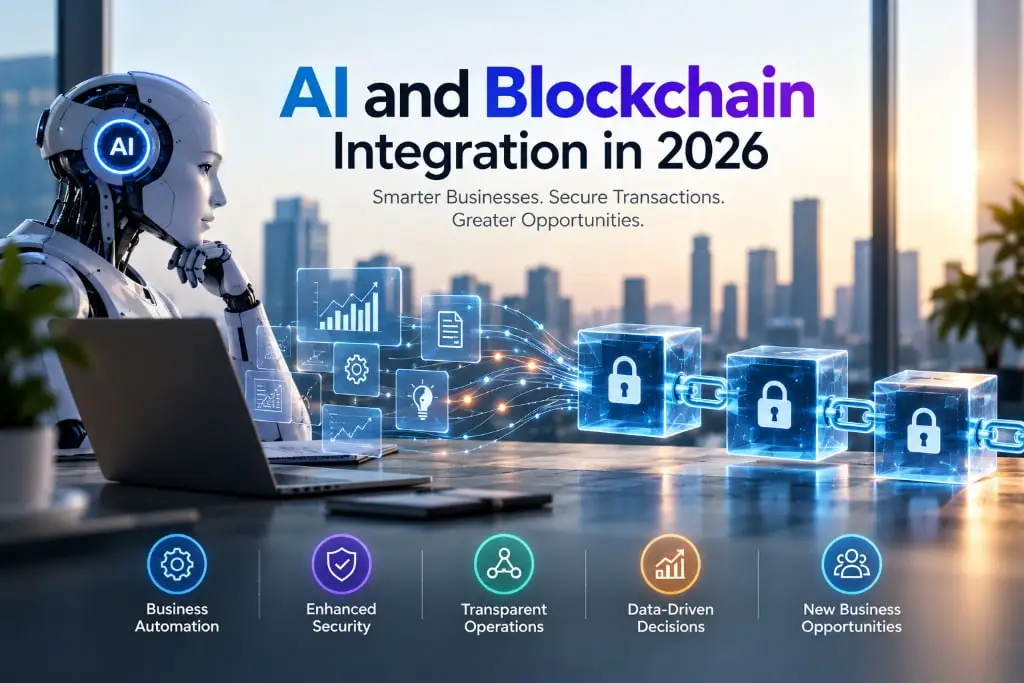
Technology is transforming how businesses operate, manage data, and serve customers. In 2026, blockchain development is becoming increasingly relevant for businesses looking to improve transparency, security, and operational efficiency. When combined with Artificial Intelligence (AI), blockchain can help organizations build smarter digital solutions, automate workflows, and maintain verifiable transaction records.
AI and blockchain integration combines the analytical capabilities of AI with the transparency and traceability of blockchain technology. From supply chain management to financial services, this combination creates new opportunities for businesses seeking digital transformation through innovative technology solutions.
What Is AI and Blockchain Integration?
AI and blockchain integration refers to combining artificial intelligence technologies with blockchain networks to improve business processes. AI can identify patterns, predict outcomes, and automate data analysis, while blockchain helps maintain traceable records and enables predefined rules through smart contracts.
For example, an AI system can analyze supplier invoices and flag unusual transactions. After an authorized person approves an invoice, a smart contract can execute a payment according to predefined conditions, while the blockchain records the transaction.
This approach can help businesses improve efficiency while maintaining better visibility into important activities.
How Do AI and Blockchain Work Together?
AI and blockchain serve different purposes but can complement each other effectively.
- AI and machine learning: Analyze data, detect anomalies, and generate predictions.
- Blockchain technology: Maintains verifiable transaction records shared across authorized participants.
- Smart contracts: Execute predefined actions when specified conditions are satisfied.
- APIs and oracles: Connect blockchain applications with external systems and data sources.
In many implementations, AI processes information outside the blockchain, while selected transactions, approvals, or verification records are stored on-chain. This approach helps manage performance, privacy, and operational costs.
Top Business Use Cases of AI and Blockchain Integration
1. Supply Chain Management
Businesses can combine AI-powered demand forecasting with blockchain-based product tracking. AI identifies potential delays or inventory shortages, while blockchain records product movements and important supply chain events.
This can improve traceability, support inventory planning, and help businesses investigate discrepancies.
2. Finance and Fraud Detection
Financial organizations can use AI to identify suspicious transactions and unusual spending patterns. Blockchain can provide auditable transaction histories, while smart contracts can automate specific payment workflows under approved rules.
Together, these technologies can support fraud monitoring and improve transaction visibility.
3. Healthcare Data Management
Healthcare organizations can explore blockchain for recording authorized data access and AI for analyzing medical information. Appropriate access controls can support secure collaboration between authorized parties.
Sensitive medical information should be protected through suitable privacy measures rather than automatically storing it directly on a public blockchain.
4. Smart Contract Automation
AI can analyze business information and recommend actions, while smart contracts execute predefined rules. Potential applications include invoice processing, insurance workflows, and supplier payments.
However, AI-generated recommendations should be validated before triggering high-impact financial or operational actions.
Key Benefits for Businesses
Integrating AI and blockchain can offer several potential advantages:
- Improved automation: Reduce repetitive manual tasks through intelligent workflows.
- Greater transparency: Maintain traceable records of important transactions and approvals.
- Better fraud detection: Use AI to identify suspicious patterns for further investigation.
- Efficient decision-making: Analyze operational data to support informed business decisions.
- Stronger accountability: Create auditable records of selected business activities.
- Better collaboration: Enable authorized organizations to share consistent transaction records.
Actual results depend on data quality, implementation, security controls, and the suitability of these technologies for the business problem.
Blockchain App Development: Turning Business Ideas into Digital Solutions
Businesses looking to implement these capabilities may require customized blockchain app development to address their specific operational challenges. Depending on the project, blockchain applications can support secure transaction processing, supply chain tracking, decentralized platforms, digital asset management, and smart contract automation.
The development process typically involves understanding business requirements, selecting a suitable blockchain network, designing the application architecture, integrating APIs and smart contracts, and conducting security and performance testing.
Choosing the right development approach helps businesses create solutions that integrate with existing systems while supporting future growth.
Challenges of AI and Blockchain Integration
Despite its potential, this integration comes with important challenges. AI systems can produce inaccurate predictions, while smart contracts may contain security vulnerabilities. Blockchain transactions can also involve fees, latency, and privacy considerations.
Businesses should conduct security audits, validate AI outputs, restrict system permissions, and establish human approval processes for sensitive decisions. They should also evaluate regulatory requirements and integration with existing software before deployment.
Importantly, blockchain can make recorded information difficult to alter, but it cannot guarantee that the original information was accurate.
How Much Does AI and Blockchain Integration Cost?
The cost of AI and blockchain development depends on project complexity, blockchain selection, AI model requirements, integrations, security testing, and ongoing maintenance.
A basic proof of concept generally requires fewer resources than a full enterprise solution involving multiple systems, advanced AI capabilities, and complex smart contracts.
Before starting development, businesses should define their objectives, identify essential features, and assess the expected return on investment. A customized estimate can help establish a realistic budget and implementation roadmap.
Future of AI and Blockchain Development
AI agents, automated digital transactions, verifiable records, and blockchain interoperability are important areas to watch. Businesses may increasingly explore systems in which AI assists with decisions while blockchain supports transaction traceability and rule-based execution.
Successful adoption will depend on practical business value, security, regulatory compliance, and responsible implementation rather than technology trends alone.
Conclusion
AI and blockchain integration offers businesses new ways to improve automation, transaction visibility, and data-driven decision-making. From supply chain management to financial operations, these technologies can support more efficient digital workflows when implemented appropriately.
At Atina Technology, we help businesses explore technology solutions aligned with their digital transformation goals. If you are planning a blockchain project, our team can help you evaluate your requirements and explore a suitable development approach.
Contact Atina Technology to discuss your blockchain development requirements and discover how a customized solution can support your business objectives.