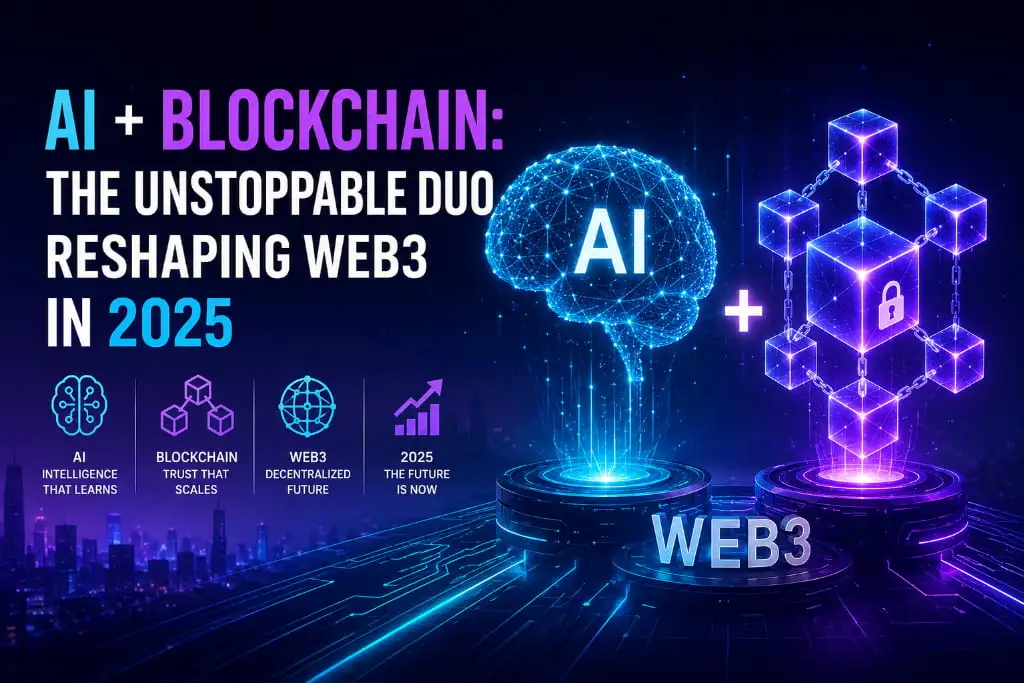
Let’s be honest — both AI and blockchain have spent years being overhyped individually.
AI was supposed to replace every job. Blockchain was going to decentralize everything overnight. Neither happened quite like that. But something interesting is going on in 2026: these two technologies are quietly coming together — and the combination is turning out to be far more powerful than either one alone.
This isn’t hype. This is happening right now, in real products, real platforms, and real businesses.
Let’s break it down in plain English.
Why AI and Blockchain Are a Natural Fit
Think of it this way.
AI is incredibly smart but hard to trust. It makes decisions, generates content, and processes data at speeds no human can match — but it’s a black box. You often can’t see how it reached a conclusion, who owns the data it trained on, or whether it’s been tampered with.
Blockchain is incredibly transparent but not very intelligent. It records everything permanently and makes data verifiable — but on its own, it can’t make decisions or learn from patterns.
Put them together and you get something genuinely powerful: AI that can be verified, audited, and trusted.
That’s the real story of 2026.
What’s Actually Changing in Web3 Right Now
1. AI Agents Are Running on Blockchain
One of the biggest shifts happening in Web3 right now is the rise of autonomous AI agents — programs that can act independently, make decisions, and even transact on your behalf.
The problem? If an AI agent is managing your money or executing smart contracts, how do you know it’s doing what it’s supposed to? How do you audit it? How do you hold it accountable?
Blockchain solves this. By recording every action an AI agent takes on an immutable ledger, developers and users can audit the full history of decisions. Projects like Fetch.ai and Autonolas are already building platforms where AI agents operate transparently on-chain — and the adoption curve is moving fast.
2. Decentralized AI Is Breaking Big Tech’s Monopoly
Right now, most AI runs on servers owned by a handful of companies — Google, Microsoft, Amazon. If they decide to shut you out, change their pricing, or alter how their models work, you have no recourse.
Decentralized AI platforms are changing that. Networks like Bittensor allow independent contributors to share computing power and AI models on a blockchain-based network. Nobody owns it. Nobody controls it. The best models get rewarded with tokens.
This is a massive deal for developers and businesses who want access to powerful AI without being locked into Big Tech infrastructure. In 2026, this space is growing faster than almost anything else in Web3.
3. Blockchain Is Solving AI’s Fake Content Problem
Here’s a problem that’s getting worse by the day: deepfakes, AI-generated misinformation, and synthetic media are flooding the internet. How do you know if a photo, video, or article is real?
Blockchain offers a solution that’s elegant in its simplicity. By recording the origin and ownership of digital content on-chain at the moment of creation, you create a permanent, tamper-proof certificate of authenticity. Platforms building on this idea — like the Content Authenticity Initiative — are already working with major media companies.
In 2026, as AI-generated content explodes, blockchain-based provenance tracking is becoming critical infrastructure for the internet.
4. Smarter Smart Contracts
Traditional smart contracts are essentially if-this-then-that rules written in code. They’re powerful but rigid. They can’t interpret context, learn from data, or adapt to changing conditions.
AI is changing that. By feeding real-world data and machine learning models into smart contract logic, developers are building contracts that can dynamically adjust — whether that’s adjusting insurance payouts based on real weather data, or repricing DeFi loans based on predicted market movements.
This is sometimes called “intelligent contracts” and it’s one of the most exciting developments in blockchain development right now.
5. Fraud Detection and Security Get a Major Upgrade
Blockchain networks process billions of dollars in transactions daily. Hackers are sophisticated, fast, and relentless. Traditional rule-based security systems can’t keep up.
AI-powered security tools trained on on-chain data can now detect unusual patterns, flag suspicious wallet behavior, and even predict attacks before they happen. Companies like Chainalysis and Nansen have been layering AI on top of blockchain data for years — but in 2026, this capability is going mainstream across DeFi, NFT platforms, and enterprise blockchain applications.
What This Means for Businesses in 2026
If you’re building a product or running a business that touches data, transactions, or digital trust — the AI + blockchain combination is no longer optional reading. It’s a competitive advantage for those who move early, and a catch-up problem for those who wait.
The companies investing in this space now will define what the next generation of the internet looks like.
Ready to Build at the Intersection of AI and Blockchain?
At Atina Technology, we don’t just follow trends — we build the technology behind them. We are experts in blockchain development, Web3 architecture, and decentralized application design. Whether you’re exploring AI-powered smart contracts, decentralized AI platforms, or blockchain-based security solutions, our team has the hands-on expertise to bring your vision to life.
Contact us today — let’s build something that actually moves the needle.
Atina Technology — Where blockchain expertise meets next-generation innovation.