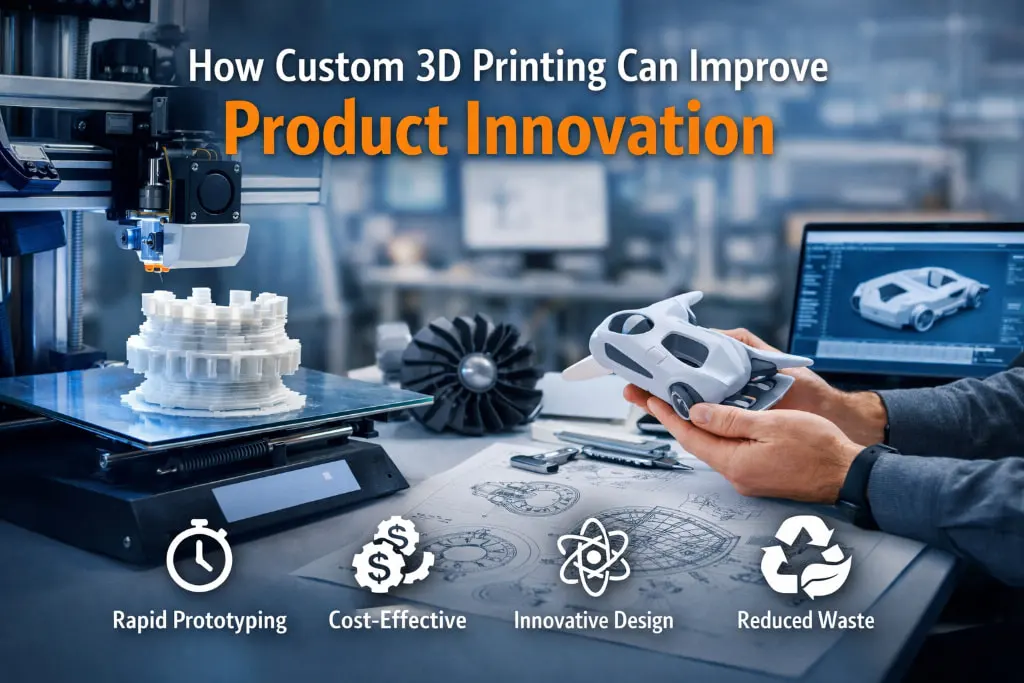
In today’s fast-paced market, innovation is the key to staying ahead of competitors. Businesses are constantly searching for faster, smarter, and more cost-effective ways to design and develop products. This is where custom 3D printing is changing the game.
From startups to large manufacturing companies, custom 3D printing is transforming how products are designed, tested, and launched. Instead of relying on traditional manufacturing methods that take weeks or months, companies can now bring their ideas to life in just a few hours.
Let’s explore how custom 3D printing is driving product innovation across industries.
1. Faster Product Development
One of the biggest advantages of custom 3D printing is speed. Traditional product development involves multiple stages like design, prototyping, tooling, and manufacturing, which can take a long time.
With 3D printing, businesses can create prototypes almost instantly. Designers can quickly print a product model, test it, make changes, and print a new version within the same day.
This rapid prototyping helps companies:
- Reduce product development time
- Test multiple design concepts quickly
- Launch products faster in the market
For startups and innovators, this speed can make a huge difference between success and missed opportunities.
2. Cost-Effective Prototyping
Traditional manufacturing often requires expensive molds and tools, which can cost thousands of dollars before a single product is made.
Custom 3D printing eliminates the need for these expensive tools. Designers can simply upload a digital design and print a prototype.
This makes it much more affordable to experiment with new ideas. Businesses can test multiple versions of a product without spending a huge budget.
As a result:
- Innovation becomes more accessible
- Small businesses can compete with large companies
- Product design becomes more flexible
3. Unlimited Design Freedom
Traditional manufacturing methods often limit product designs because of tooling restrictions. Complex shapes or intricate structures may be difficult or impossible to produce.
Custom 3D printing removes these limitations. Designers can create complex geometries, lightweight structures, and customized designs that were not possible before.
For example:
- Medical implants can be customized for each patient
- Automotive parts can be made lighter and stronger
- Consumer products can have unique designs
This design freedom encourages creativity and innovation in product development.
4. Easy Product Customization
Modern consumers prefer products that are personalized according to their needs. Custom 3D printing allows companies to easily create customized products without increasing production costs significantly.
Industries using customization include:
- Healthcare (custom prosthetics and dental aligners)
- Fashion (custom accessories and jewelry)
- Consumer products (personalized gadgets and tools)
Instead of mass-producing identical products, businesses can now produce tailor-made solutions for their customers.
5. Reduced Material Waste
Sustainability is becoming a major concern for businesses and consumers. Traditional manufacturing often produces a lot of waste because material is cut away during production.
3D printing uses an additive manufacturing process, which means material is added layer by layer to create the product. This reduces waste and makes the production process more environmentally friendly.
Benefits include:
- Lower material costs
- Reduced environmental impact
- More efficient use of resources
This makes custom 3D printing a smart choice for sustainable product innovation.
6. Improved Testing and Iteration
Innovation requires constant testing and improvement. Custom 3D printing allows engineers and designers to quickly test different versions of a product.
If a design does not work perfectly, it can be modified and reprinted immediately. This rapid iteration process helps businesses refine their products before mass production.
This results in:
- Better product performance
- Higher product quality
- Fewer manufacturing errors
Companies can ensure that their final product is optimized and ready for the market.
7. Encouraging Innovation for Startups
For startups, entering the product development market can be challenging due to high manufacturing costs. Custom 3D printing lowers these barriers.
Entrepreneurs can quickly create prototypes, showcase their ideas to investors, and test products with customers.
Many successful startups have used 3D printing to:
- Validate product ideas
- Create prototypes for crowdfunding campaigns
- Build innovative products without large factories
This technology empowers innovators to turn creative ideas into real products.
The Future of Product Innovation with 3D Printing
As 3D printing technology continues to evolve, its role in product innovation will become even more powerful. Advanced materials, faster printers, and improved design software are making it possible to create products that were unimaginable just a few years ago.
Industries like aerospace, healthcare, automotive, and consumer electronics are already using 3D printing to develop cutting-edge products.
In the future, we can expect:
- On-demand manufacturing
- Hyper-personalized products
- Faster innovation cycles
Custom 3D printing is not just a manufacturing tool—it is a powerful driver of innovation.
Conclusion
Custom 3D printing is revolutionizing the way products are designed and developed. With faster prototyping, lower costs, unlimited design possibilities, and sustainable production methods, it enables businesses to innovate like never before.
Companies that embrace this technology can develop better products, reduce development time, and stay ahead in the competitive market.
At Atina Technology, we specialize in advanced technology solutions and innovation-driven services. Our expertise helps businesses leverage modern technologies to build smarter, more efficient, and future-ready products.