
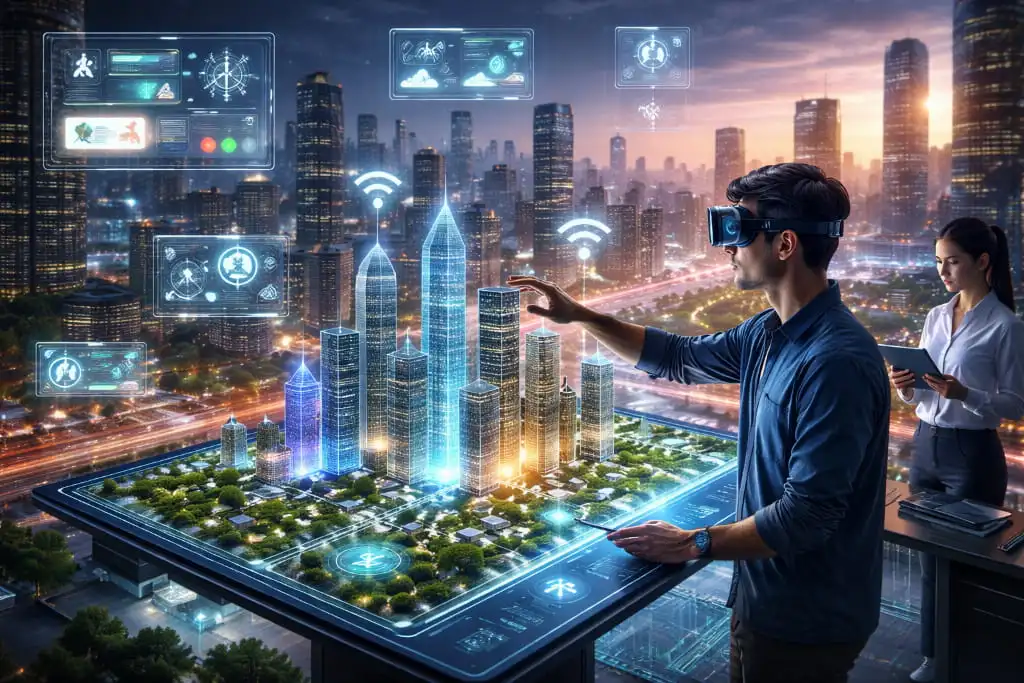
Smart cities are no longer just a futuristic concept—they are becoming a reality across the world. With rapid urbanization, governments and city planners are adopting advanced technologies to improve infrastructure, sustainability, and quality of life. Among these technologies, Augmented Reality (AR) and Virtual Reality (VR) are playing a crucial role.
From city planning and traffic management to citizen engagement and disaster preparedness, AR VR development is reshaping how modern cities are designed and managed.
Understanding AR & VR in Smart Cities
Augmented Reality overlays digital information onto the real world using smartphones, tablets, or AR glasses. Virtual Reality, on the other hand, creates a fully immersive digital environment using VR headsets. In smart cities development, these technologies are used together to visualize data, simulate scenarios, and enhance decision-making.
AR & VR in Smart City Planning and Infrastructure
One of the biggest challenges in urban development is visualizing complex infrastructure before construction begins. AR and VR solve this problem efficiently.
- VR-based city simulations allow planners to walk through 3D city models before a single brick is laid.
- AR-powered overlays help engineers view underground utilities such as water pipelines, gas lines, and electrical networks in real time.
This reduces planning errors, saves cost, and speeds up project approvals. Digital twins created through VR app development are now widely used for smart city infrastructure planning.
Improving Traffic Management and Transportation
Traffic congestion is a major issue in urban areas. AR VR solutions provide real-time and predictive insights for traffic management.
- VR simulations help authorities test new road layouts, flyovers, and metro routes.
- AR-based navigation systems provide real-time traffic updates, accident alerts, and smart parking guidance.
By integrating AR VR development services with AI and IoT, smart cities can significantly reduce traffic congestion and improve commuter safety.
Smart Utilities and Energy Management
Energy efficiency is a core goal of smart cities. AR and VR play a vital role in monitoring and maintaining utilities.
- AR allows technicians to view live data from smart grids, water supply systems, and power stations.
- VR enables remote training and virtual inspections of power plants and renewable energy installations.
Using augmented reality solutions, maintenance teams can fix problems faster, reducing downtime and operational costs.
AR & VR for Public Safety and Disaster Management
Public safety is another critical area where AR and VR technologies are making a big impact.
- VR-based disaster simulations help emergency teams train for earthquakes, floods, and fires.
- AR applications provide real-time evacuation routes and safety instructions during emergencies.
These immersive tools improve response time and save lives, making virtual reality development essential for disaster-ready smart cities.
Enhancing Citizen Engagement and Governance
Smart cities are not just about technology—they are about people. AR and VR help bridge the gap between governments and citizens.
- AR apps allow citizens to visualize upcoming infrastructure projects in their neighborhoods.
- VR town halls enable residents to experience proposed city changes and give feedback virtually.
This increases transparency, trust, and participation in governance while improving overall urban planning outcomes.
AR & VR in Smart Healthcare and Education
Healthcare and education are key pillars of smart cities.
- VR is used for medical training, virtual surgeries, and mental health therapy.
- AR assists doctors with real-time patient data visualization.
- In education, VR classrooms and AR-based learning modules provide immersive learning experiences.
These use cases highlight the growing demand for AR app development and VR app development in public sectors.
The Future of AR & VR in Smart Cities
As 5G, AI, and IoT continue to evolve, AR and VR will become even more powerful. Future smart cities will rely on immersive technologies for predictive maintenance, real-time analytics, and citizen-centric services. Businesses searching for “AR VR development company” or “smart city AR VR solutions” will play a vital role in shaping this future.
Atina Technology welcomes you — we are expert in AR VR development, offering innovative, scalable, and customized solutions for smart cities, real estate, healthcare, education, and enterprise applications.
Conclusion
AR and VR are no longer optional technologies—they are essential tools for smart cities development. By enabling better planning, efficient resource management, improved safety, and enhanced citizen engagement, AR VR development is transforming urban living. Cities that adopt these immersive technologies today are building a smarter, safer, and more sustainable tomorrow.
If you are planning to integrate augmented reality solutions or virtual reality development into your smart city project, now is the perfect time to take the next step with expert guidance.