
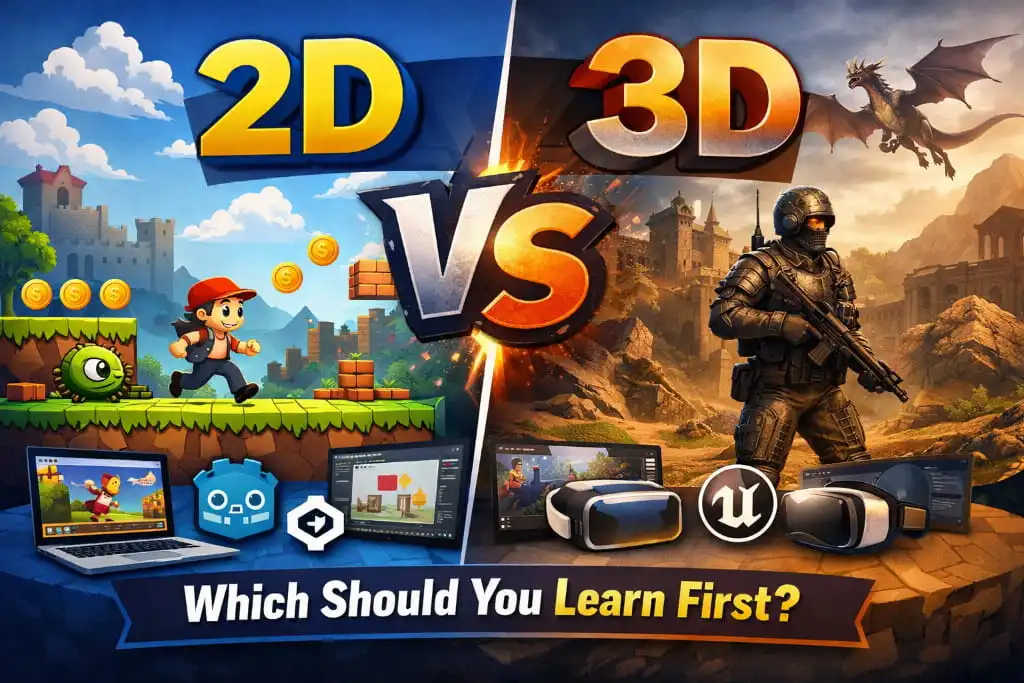
Entering the world of game development is exciting, but beginners often get confused at the very first step—should you start with 2D game development or jump straight into 3D game development?
Both have massive demand, powerful tools, and strong career opportunities. However, the right choice depends on how you want to learn, what you want to build, and where you want your career to go.
Let’s break this down in a clear, beginner-friendly way.
Understanding 2D Game Development (The Foundation Layer)
2D game development involves creating games using flat visuals that work on height and width only. These games may look simple, but they form the backbone of strong game logic and mechanics.
Why 2D Games Are Still Popular
Despite advanced graphics, 2D games dominate mobile game development and indie platforms due to their simplicity and performance efficiency.
Key Advantages of 2D Game Development
- Easy for beginners to learn
- Less complex mathematics and physics
- Faster game creation and testing
- Lower system and development cost
- Perfect for mobile and browser games
Exploring 3D Game Development (The Immersive Layer)
3D game development creates games with depth, realism, and immersive environments. Characters, worlds, and objects exist in a three-dimensional space, providing a more lifelike experience.
What Makes 3D Games Stand Out
- Realistic characters and environments
- Advanced lighting, shadows, and textures
- Used in PC, console, AR, VR, and metaverse games
- Higher production value and market demand
Challenges in 3D Game Development
- Steeper learning curve
- Requires knowledge of 3D math and physics
- Longer development time
- High-performance hardware requirements
2D vs 3D Game Development: Quick Comparison
|
Aspect |
2D Game Development | 3D Game Development |
|
Difficulty Level |
Beginner-friendly | Intermediate to Advanced |
|
Visual Style |
Flat graphics | Realistic & immersive |
| Development Speed | Fast |
Slower |
|
Cost & Resources |
Low |
High |
| Best For | Mobile & Indie Games |
PC, Console, AR/VR |
| Learning Curve | Smooth |
Steep |
This comparison shows why many beginners prefer starting with 2D game development before advancing to 3D.
Game Engines That Power 2D and 3D Games
Your learning experience depends heavily on the game engine you choose.
Best Engines for 2D Games
- Unity
- Godot Engine
- Cocos2d
Best Engines for 3D Games
- Unreal Engine
- Unity
- CryEngine
Unity is especially popular because it supports both 2D and 3D game development, allowing developers to switch smoothly as they grow.
Which Path Is Right for You?
Start With 2D Game Development If:
- You are completely new to programming
- You want to understand game mechanics clearly
- You aim to build mobile or casual games
- You prefer quick progress and motivation
Start With 3D Game Development If:
- You already know basic coding concepts
- You want to work on realistic or AAA-style games
- You are interested in VR, AR, or simulation projects
- You enjoy complex visual systems
Industry Insight: Many professional game developers learn 2D first, then upgrade to 3D game development once their fundamentals are strong.
Career Scope and Opportunities
The gaming industry offers diverse opportunities for both skill sets:
- 2D game developers are highly demanded in mobile gaming and indie studios
- 3D game developers dominate AAA studios, VR companies, and simulation firms
- Freelancers and indie creators can earn through ads, in-app purchases, and publishing platforms
Mastering either path builds a strong career, but knowing both 2D and 3D game development gives you a major competitive edge.
Final Thoughts: What Should You Learn First?
If your goal is to learn faster, build confidence, and understand core game development concepts, start with 2D game development. Once you’re comfortable with logic, physics, and animations, transitioning to 3D game development becomes much easier and more rewarding.
Game development is a journey—not a single choice.
Atina Technology welcomes you — we are expert in Game Development, helping learners and businesses transform creative ideas into powerful gaming experiences.